
Glass Safety Auditor Register™
In health and safety legislation, competence is defined by a combination of skills, knowledge, experience, and training, rather than a single specific qualification. For a glass safety inspection, assessment, or audit, a truly competent person must possess a blend of glass-specific technical knowledge, a deep understanding of relevant structural and safety standards, and practical experience with risk assessment methodologies
THE THREE CORE PILLARS
1. Essential Knowledge & Technical Competencies
- Regulatory Compliance: They must be expert in Regulation 14 of the Workplace (Health, Safety and Welfare) Regulations 1992 (which mandates safe breakage in commercial properties), Approved Document K of the Building Regulations (critical locations), and BS 6262 Part 4 (glazing safety codes).
- Glass Identification & Material Science: The ability to distinguish between float glass, toughened (tempered) glass, and laminated glass. They should know how to interpret kitemarks, European/UK markings (like BS EN 12600), or utilise specialist glass-analysing equipment (such as UV or laser meters) to verify the composition of unmarked or older glass.
- Critical Locations & Manifestation: Exact knowledge of where safety glass is legally mandatory (e.g., below 800mm from floor level, or within 300mm of a door) and where visual manifestation markings are required to prevent collisions.
- Defect Recognition: Knowing how to differentiate between cosmetic scratches and structural stress, recognising failed Insulated Glass Units (misted double-glazing), and assessing deteriorated structural silicone or perimeter gaskets.
2. Relevant Experience
- Site-Specific Context: A competent person should have documented experience inspecting buildings with a similar risk profile. An auditor experienced only in low-rise retail environments may not be competent to assess complex overhead glazing, atrium structural silicone, or high-risk environments like schools and hospitals.
- Use of Equipment: Experience in structural access methods (scaffolding, MEWPs) or the correct application and assessment of remedial measures, such as applying heavy-duty safety film to non-compliant glass.
3. Industry-Recognized Qualifications
- Trade Vetting Schemes: For installation and direct building control self-certification, registration with a Government-Authorized Competent Persons Scheme like FENSA or Certass is a strong baseline indicator of vetted technical competence.
- Glazing Inspection Bodies: Direct certifications or services from independent glazing inspection authorities, such as RISA (the inspecting arm for the glazing industry).
- Health & Safety Frameworks: Qualifications indicating they understand the principles of risk gathering, audit documentation, and report structures, such as a NEBOSH National General Certificate or an ISO 45001 Lead Auditor accreditation.
- Industry Sector Training: In highly specific sectors, specialized courses apply—such as the GGF (Glass and Glazing Federation) Managing Glass Safely course, or standard vocational training verified by bodies like GQA Qualifications.
THE SKEB
ICM Registration Criteria: Glass Safety Auditor
To be accepted onto the ICM Competence Registry™®, applicants must satisfy the mandatory elements across four distinct pillars
THE CRITERIA
Pillar 1: Professional Qualifications & Vetting
- Core Membership: Must hold an active grade of membership with the Institute of Construction Management or submit to equivalent third-party vetting under the ICM "Open Door" baseline.
- Technical Education: Minimum NVQ Level 3/4 in Glazing Inspection, Construction Management, Building Surveying, or a structural engineering discipline; or verified GQA Qualifications specialist certificates.
- H&S Frameworks: Hold a NEBOSH National General Certificate, NCRQ, or an ISO 45001 Lead Auditor qualification.
- Ethics Sign-off: Mandatory signed declaration of compliance with the ICM Code of Professional Conduct.
Pillar 2: Statutory & Legislative Knowledge
- Workplace Regulations: Regulation 14 of the Workplace (Health, Safety and Welfare) Regulations 1992 (Safe Breakage & Glazing Integrity).
- Building Regulations: Approved Document K (Protection from falling, collision and impact).
- British & European Standards: BS 6262-4 (Glazing for buildings: Code of practice for safety related to human impact) and BS EN 12600 (Classification of resistance to impact).
- Higher-Risk Buildings (HRBs): Understanding structural glazing implications under the Building Safety Act 2022 for high-rise environments.
Pillar 3: Documented Field Experience
- Portfolio Evidences: Submission of a minimum of 5 complex, redacted glass safety inspection and risk audit reports completed within the last 24 months.
- Scope Variety: Evidence of assessing diverse glazing systems, including critical low-level areas, high-manifestation collision risks, overhead glass, or structural atriums.
Pillar 4: Continual Professional Development (CPD)
- Compliance with the mandatory ICM CPD requirements (minimum 30 hours per annum, with at least 12 hours dedicated specifically to advanced glass manufacturing, defects, or changing building safety legislation).
ICM COMPETENCE ASSESSMENT MATRIX
This matrix is designed for the ICM National Register of Competency vetting process. The validation requires assessing Evidence Streams across four scoring levels (0 to 3). Candidates must score a minimum of Level 2 in all sections to gain registration.
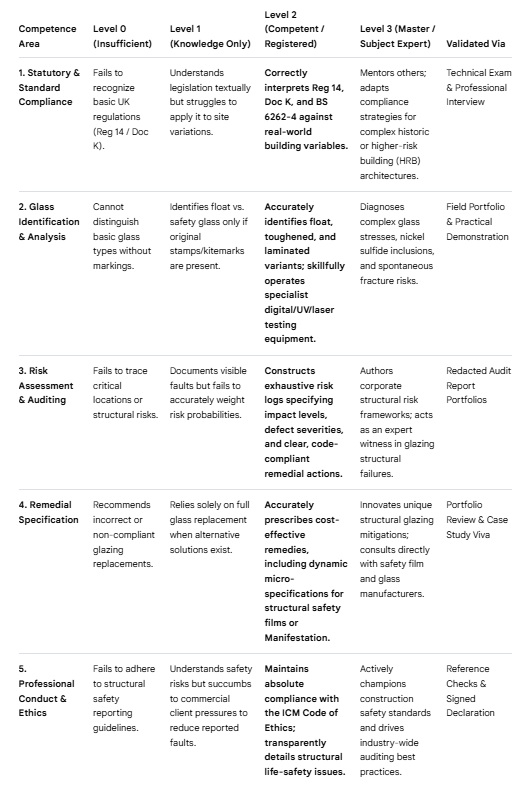
Matrix Scoring Definitions & Core Rules
- Level 0 (Fail): Deficiencies present that pose a life-safety risk or regulatory breach. Immediate rejection.
- Level 1 (Deferred): The candidate possesses theoretical understanding but lacks the necessary field experience or technical execution capability. Requires a structured mentorship period before re-assessment.
- Level 2 (Pass - Registered Status): Demonstrates full, autonomous competence to perform independent glass safety audits across standard commercial and residential properties. Granted full entry into the ICM Registry.
- Level 3 (Pass - Fellow / Senior Auditor Status): Exceptional expert competence. Eligible to act as an ICM technical assessor or panel lead for subsequent register applicants.